
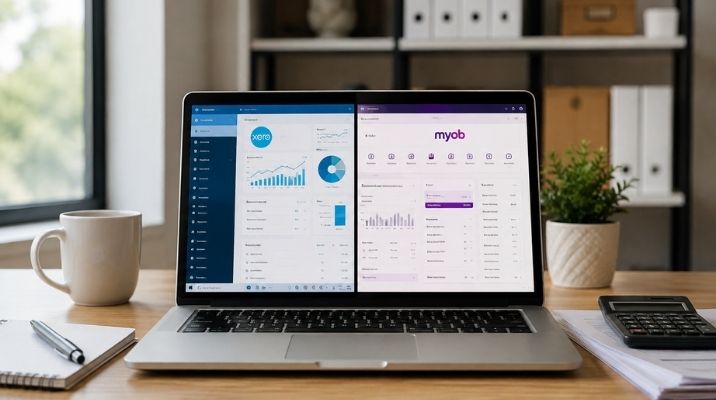
Two Platforms, Two Philosophies
Xero and MYOB have been competing for the Australian small business market for over two decades. Both handle the core accounting functions — bank reconciliation, invoicing, payroll, BAS preparation, and GST reporting. But they approach the job differently, and the right choice depends on your business, your accountant, and how you prefer to work.
This guide covers the practical differences between the two platforms so you can make an informed decision — without wading through feature lists that don’t reflect how small businesses actually use accounting software.
How They Compare
| Feature | Xero | MYOB |
|---|---|---|
| Pricing (entry) | From ~$35/mo (Ignite) | From ~$34/mo (Lite) |
| Cloud-based | Yes — fully | Yes (Business) / Desktop (AccountRight) |
| Bank feeds | Automatic, reliable | Available, improving |
| Payroll (STP) | Included in all plans (from June 2025) | Add-on — $2/mo per employee (Lite & Pro) |
| BAS lodgement | Via connected agent | Direct lodge available |
| Third-party integrations | 1,000+ apps | Fewer, growing |
| Ease of use | More intuitive for new users | Steeper learning curve |
| Accountant adoption (AU) | Very high | High, particularly older firms |
| Offline access | No | Yes (AccountRight desktop) |
The Case For Xero
Xero launched in New Zealand in 2006 and has become the dominant cloud accounting platform for Australian small businesses. Its interface is widely regarded as cleaner and more intuitive than MYOB — an advantage for business owners who manage their own books without a dedicated finance background.
Bank feeds are one of Xero’s genuine strengths. Connections are generally more reliable and cover a wider range of Australian financial institutions, which matters for day-to-day reconciliation. The automated matching rules reduce manual coding time significantly once set up correctly.
Integrations are another differentiator. Xero’s app marketplace includes over 1,000 third-party tools — from inventory management and time tracking to debtor management and payroll add-ons. If your business relies on specialist software, Xero is more likely to connect to it natively.
Accountant adoption in Australia is very high. Most bookkeepers and accounting firms are Xero-certified, and many operate exclusively on the platform. If your accountant uses Xero, staying on Xero is the path of least friction.
The main limitation is pricing. Xero’s plans have increased significantly in recent years, and the entry-level Ignite plan has meaningful restrictions on invoices and bills. For businesses with moderate transaction volumes, the mid-tier Grow plan is typically required. Payroll and auto super are now included in all Xero plans — a significant change that removed the need for a separate payroll add-on.
The Case For MYOB
MYOB has been part of the Australian accounting landscape since the early 1990s. It remains widely used, particularly among businesses that were established before Xero’s rise and have never migrated — and among accountants and bookkeepers trained on the platform.
Direct BAS lodgement is a practical advantage. MYOB Business allows activity statements to be lodged directly from within the software without needing a separate agent connection, which can simplify the compliance workflow for some businesses.
Pricing at the entry level is broadly comparable with Xero — MYOB Business Lite starts at $34/month and Pro at $63/month. Note that payroll is no longer included in Lite and Pro plans; it is charged at an additional $2 per month per employee. For businesses with no payroll requirements, MYOB’s entry price is competitive.
AccountRight — MYOB’s desktop product — remains relevant for businesses that need offline access or operate in locations with unreliable internet. It is a meaningful differentiator for regional businesses or those that process large volumes of transactions locally.
The main limitations are the interface and the integration ecosystem. MYOB’s cloud product has improved significantly, but new users generally find it less intuitive than Xero. The third-party app marketplace is also considerably smaller, which can be a constraint for businesses with complex operational needs.
The honest answer
For most Australian small businesses starting today, Xero is the default choice — not because MYOB is inadequate, but because Xero’s accountant adoption, integration ecosystem, and ease of use create fewer points of friction over time. The exception is if your existing accountant operates primarily on MYOB, in which case staying aligned with your accountant is worth more than platform preference.
What About Switching Platforms?
Migrating from MYOB to Xero — or vice versa — is possible but not trivial. Chart of accounts, historical transaction data, payroll history, and opening balances all need to be carried across correctly to avoid discrepancies. For most businesses, migration is best done at the start of a new financial year to minimise the reconciliation complexity.
If you are considering switching, the best first step is to raise it with your accountant or bookkeeper before committing. They can assess whether migration makes sense for your situation and manage the transition without disrupting your compliance obligations. See our bookkeeper cost guide if you are also reviewing your current pricing arrangement.
Which Platform Does Advancr Use?
advancr works with both. Our bookkeeping service is compatible with Xero, MYOB, and QuickBooks — we work directly within your existing platform without requiring migration or disruption. If you are not yet on a cloud platform, we can advise on the right setup for your business before onboarding. We serve businesses across Australia including Sydney, Melbourne, Brisbane, and Perth.
Frequently Asked Questions
Is Xero or MYOB better for small businesses in Australia?
For most new Australian small businesses, Xero is a strong choice because it is easy to use, has a large range of integrations, and is widely used by accountants and bookkeepers. MYOB can be a better fit for businesses that already use MYOB or need offline access.
Is Xero cheaper than MYOB in Australia?
Xero and MYOB have similar entry-level pricing, but the total cost depends on the plan, payroll requirements, number of transactions, and features your business needs. It is worth comparing the plans based on your actual business requirements rather than the starting price alone.
Which is better for BAS lodgement, Xero or MYOB?
MYOB can be advantageous if you want to lodge activity statements directly through the software. With Xero, BAS lodgement can be handled through a connected registered tax or BAS agent.
Which accounting software is better for a new business in Australia?
Xero is generally a good option for a new business that wants simple cloud accounting, strong integrations and an easy-to-use platform. However, your accountant’s preferred software should also be considered before making a decision.
What is the difference between a bookkeeper and an accountant?
A bookkeeper handles day-to-day financial records — reconciliation, invoicing, payroll, and BAS preparation. An accountant provides higher-level analysis, tax planning, and end-of-year tax returns. Most small businesses need both, though some bookkeeping firms handle routine tax obligations as well.